Mortgage Refinance Letter Scam
That official-looking
mortgage letter is not
from your lender.
Predatory mortgage mailers are designed to look like correspondence from your servicer. Here is how they work, what they are actually saying, and how to stop them from reaching you.
It arrived looking like official correspondence. A reference number printed twice. Your exact mortgage amount. A new rate. An estimated escrow refund. Language about eligibility and seasoning requirements. The kind of letter you assume came from your servicer because it knows things your servicer would know. What you are holding is a mortgage refinance letter scam — technically legal, deliberately misleading, and sent to thousands of homeowners every month.
It did not come from your servicer. It came from a company that purchased your personal financial information from a credit bureau the last time your credit was pulled. They know your mortgage amount, your address, and your name because they paid for that data — not because they have any relationship with your loan. A mortgage refinance letter scam does not need to lie outright to mislead you. The letter is engineered to look like something it is not, and it is legal.
This page breaks down exactly how these mailers work, what the language is designed to make you believe versus what it actually says, the math they are counting on you not to run, and the specific steps you can take to stop your information from being sold in the first place.
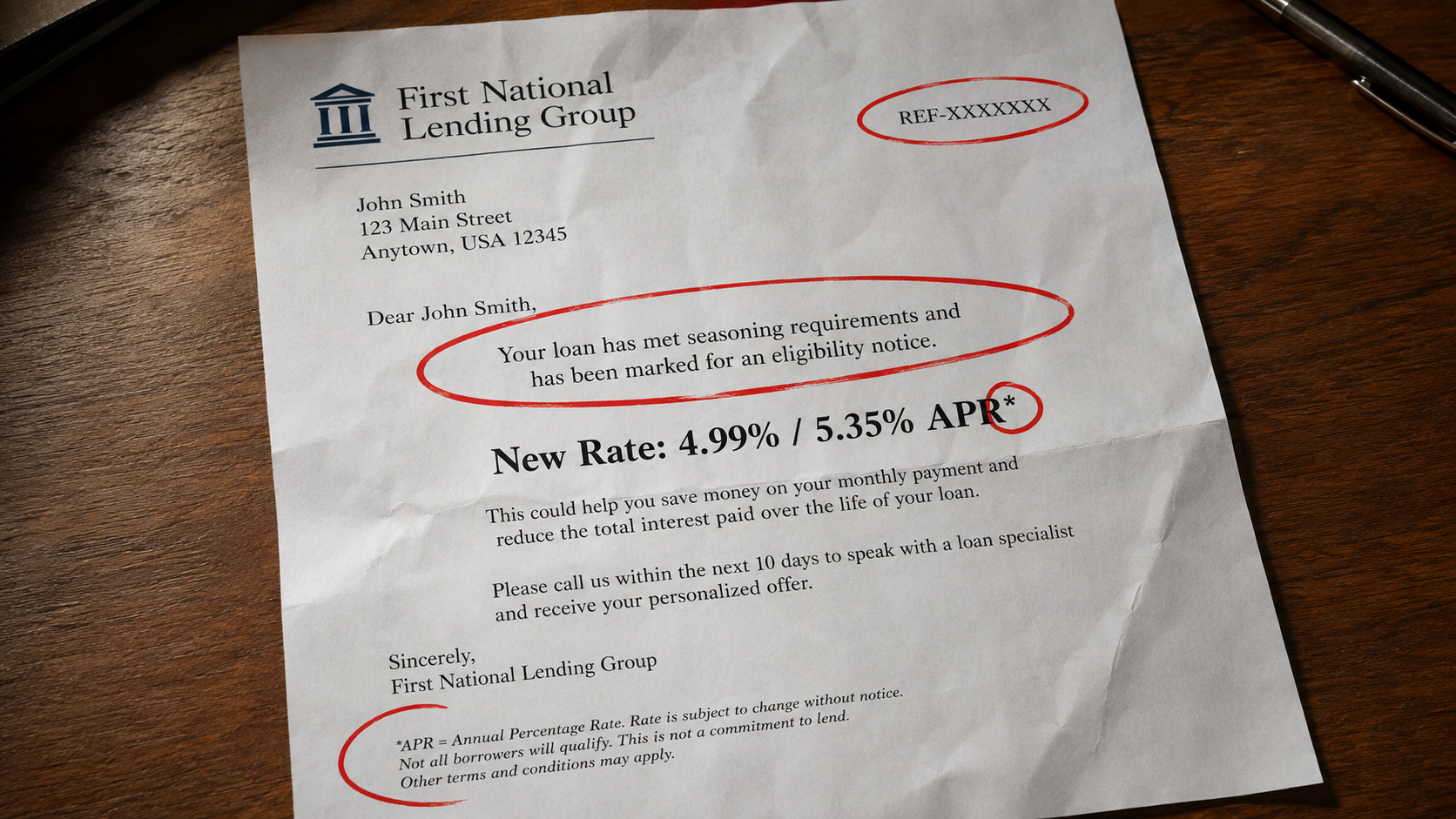
They know your mortgage amount because they bought that information. Not because they are your lender.
What is a trigger lead — and how did they get your information?
When a lender pulls your credit report as part of a mortgage application or refinance inquiry, that credit pull creates what is known in the industry as a trigger lead. Historically, the major credit bureaus — Equifax, Experian, and TransUnion — were permitted to sell that event as a data product to competing lenders. The trigger lead told them you were actively shopping for a mortgage, making you a high-intent prospect worth paying for.
The result was that within days of a credit inquiry, homeowners began receiving calls, texts, and mailers from lenders they had never contacted, quoting rates and terms based on data pulled directly from their credit file. Every mortgage refinance letter scam in your mailbox traces back to this data pipeline. The practice was legal under the Fair Credit Reporting Act’s prescreening provisions, and it was widespread.
New as of March 5, 2026: The Homebuyers Privacy Protection Act amended the Fair Credit Reporting Act to significantly restrict trigger lead sales. Credit bureaus are now prohibited from selling trigger lead data to third parties based on a mortgage credit inquiry unless the consumer has affirmatively opted in. Lenders must have an existing relationship with the borrower to use this data. The era of mass trigger lead solicitation is legally over — but data sold before the law took effect, and companies operating in remaining legal exceptions, mean these mailers have not disappeared entirely.
Mortgage refinance letter scam — a real mailer analyzed line by line
The following is an analysis of an actual mortgage solicitation mailer received in August 2026. The recipient’s personal information and the soliciting company’s identifying details have been redacted to avoid any implication of specific wrongdoing by a named entity — these tactics are industry-wide, not unique to any one company. The structure, language, and design patterns are reproduced as they appeared.
“RE: Premier Mortgage Services Reference #: 0805LC44505 Notification Date: 8/6/2026”
The header mimics the format of official correspondence from a loan servicer or government agency. A reference number printed twice, a notification date, business hours listed in the corner. None of this indicates any official relationship with your loan. The reference number is an internal tracking code for the solicitor’s mail campaign. The “notification” framing implies you are required to respond. You are not.
“Your loan funded through Premier Mortgage Services has met seasoning requirements and has been marked for an eligibility notice.”
“Seasoning requirements” is real mortgage terminology — it refers to how long a loan must be active before it can be refinanced. Using it here creates the impression that your existing servicer has reviewed your account and determined you qualify for something. This company has no access to your loan status, your payment history, or your servicer’s systems. They know your original loan amount from the credit bureau data they purchased. That is the full extent of their knowledge about your mortgage.
“New Rate: 4.99% / 5.35% APR*”
The asterisk leads to fine print that reveals the APR shown is based on an entirely different loan scenario: a $315,000 conventional 30-year fixed loan at 75% loan-to-value with a 700 credit score — rate and term refinance only. The recipient’s actual loan was $365,000. The rate advertised is not for the loan described in the letter. This is technically legal because of the disclosure. It is designed to be missed.
“Estimated Escrow Refund: $2,920.00”
This number is fabricated. The soliciting company has no access to your escrow account, your current balance, your tax and insurance payments, or any other data that would produce an escrow refund estimate. The number exists to make the offer feel personal, concrete, and financially immediate. It is a marketing figure dressed as a financial fact.
“Take available cash of $25,000.00 or more”
Buried in what reads as a rate reduction notice is the actual product being sold: a cash-out refinance. This is not a rate improvement — it is a new loan that replaces your existing mortgage, resets your amortization clock to month one, and gives you cash in exchange for equity you have spent years building. The math on resetting amortization almost always favors the lender, not the borrower. More on this below.
“This program is limited to only the beneficiary above and is non-transferable.”
This language creates artificial scarcity. There is no exclusive program. The same mailer was sent to every person whose trigger lead data this company purchased. “Non-transferable” and “beneficiary” are terms borrowed from legal documents to add an air of official authority to a mass marketing piece.
The math they are counting on you not to run
Even if the rate in a mortgage refinance letter scam were real — even if 4.99% were genuinely available on your specific loan — a refinance is not automatically a good financial decision. The number the mailer does not show you is the cost of resetting your amortization schedule.
If you are three years into a 30-year mortgage, you have already paid through the most front-loaded interest period of your loan. The majority of every payment in the first several years goes to interest, not to reducing your balance. Starting a new 30-year loan means going back to month one — where the same dynamic applies all over again, at whatever the new rate is.
$1,957/mo vs. your current payment. Looks like savings. Does not show closing costs, amortization reset, or total interest over the new loan term.
Closing costs divided by monthly savings equals months to break even. If you plan to sell or refinance again before that point, the refinance costs you money — not saves it.
Run the actual numbers first: Before responding to any refinance solicitation, use the mortgage recast calculator to see your current amortization position, your crossover point, and how a refinance at the quoted rate would compare to your existing loan on a total-interest basis. The calculation takes two minutes. The decision it informs could save tens of thousands of dollars.
How to spot a mortgage refinance letter scam — the 9-point checklist
These are the consistent design patterns across every mortgage refinance letter scam. Any one of them is worth slowing down for. Several together is a strong signal to set the letter aside and verify directly with your actual servicer.
- Reference numbers printed multiple times — creates an official appearance and implies a filing or case number tied to your loan.
- Language like “notification,” “eligibility notice,” or “marked for review” — implies your existing servicer initiated the contact.
- Your exact loan amount or mortgage balance — looks like they have access to your account. They have access to credit bureau data.
- An asterisk on the rate — the fine print almost always reveals the rate applies to a different loan scenario than the one described.
- An “estimated” refund or savings figure — any specific dollar figure tied to your escrow or current payment that the sender could not actually know.
- Urgency language without a real deadline — “limited time,” “act before rates change,” “program closing soon.”
- Non-transferable, beneficiary, or program language — borrowed from legal documents to create an air of exclusivity on a mass mailer.
- No street address for the company — a PO box or suite number with no verifiable physical address is a warning sign.
- NMLS number present but unfamiliar company name — the NMLS number is required by law and is real, but it does not mean the company is affiliated with your servicer.
How to verify who actually services your loan: Your real servicer’s name and contact information is on your monthly mortgage statement and in your original closing documents. If you receive a letter claiming to be from your servicer and you are not certain, call the number on your statement — not the number in the letter — before taking any action.
How to protect your information — three layers
The good news is that protection is available and most of it is free. Every mortgage refinance letter scam relies on your information having already been sold before you knew to stop it. The new federal law changed the default from opt-out to opt-in for mortgage trigger leads, but data already sold and companies operating in remaining legal exceptions mean taking active steps still matters.
Go to optoutprescreen.com or call 1-888-5-OPT-OUT (1-888-567-8688). This tells the three major credit bureaus not to sell your information for prescreened credit and insurance offers. You can opt out for five years online or permanently by mail. The process takes about five days to process. It applies to future inquiries — solicitations already in motion from a recent credit pull may still arrive for a short period.
Under the Homebuyers Privacy Protection Act (effective March 5, 2026), lenders must have your affirmative consent or an existing relationship to use trigger lead data. When you apply for a mortgage or refinance, explicitly tell your loan officer in writing that you do not consent to your credit inquiry data being used for third-party solicitations. Ask them to note it in your file. This does not guarantee protection from all channels but creates a documented record of your intent.
Go to donotcall.gov and register your phone number. This does not stop mailers — direct mail is a separate channel — but it significantly reduces the phone calls that typically accompany trigger lead purchases. Telemarketers who call numbers on the registry are violating federal law. You can report violations at the same site.
If you have already responded to a mailer: You have not committed to anything by calling the number. However, be aware that the call is a sales conversation, not an official inquiry. The representative is a loan officer working on commission. Get any rate quote in writing, ask specifically what the APR is on your actual loan amount, ask for the full closing cost estimate, and calculate the break-even period before agreeing to anything. If the break-even is longer than you plan to stay in the home, the refinance is not in your financial interest.
When refinancing actually makes sense
Not every refinance offer is a mortgage refinance letter scam. There are circumstances where refinancing is the right move — and distinguishing a legitimate offer from a predatory solicitation is the point. The solicitation-driven offer and the genuinely useful refinance look similar on paper. The math tells them apart.
A refinance makes mathematical sense when your interest rate drops enough to produce meaningful monthly savings, when you plan to stay in the home long enough to recoup the closing costs, and when you are not resetting a loan that is already well into the amortization curve. The break-even calculation — closing costs divided by monthly payment reduction — tells you how many months until the refinance pays for itself. If you plan to sell or move before that date, the refinance costs you money.
An alternative worth understanding before refinancing is a mortgage recast. If you have a lump sum available — a tax refund, a bonus, an inheritance — and your current rate is competitive, recasting reduces your monthly payment without resetting your amortization schedule, without a credit check, and without $8,000 to $15,000 in closing costs. Most lenders charge $150 to $500 for a recast. Call your servicer and ask whether they offer it.
Frequently asked questions about mortgage refinance letter scams
Is it illegal to send misleading mortgage mailers?
Most trigger lead mailers are legal as long as they include the required disclosures — typically an asterisk explaining that the rate shown applies to a specific scenario different from the recipient’s actual loan. The FTC has pursued companies that cross into outright fraud, but the design tactics described on this page — implied servicer affiliation, manufactured escrow figures, fake exclusivity language — generally stay within legal boundaries because the disclosures, however small, are present. That is the same dynamic at work in mortgage amortization disclosure: technically compliant, strategically incomplete.
How did a company I never contacted get my mortgage information?
The most common source is a trigger lead. When a lender pulled your credit for a mortgage application, the credit bureaus were permitted to sell that event as a data product to competing lenders. Those lenders then matched the credit bureau data to public records — including property records — to obtain your loan amount and address. As of March 5, 2026, the Homebuyers Privacy Protection Act significantly restricts this practice, but data sold before the law took effect and remaining legal exceptions mean these mailers have not disappeared entirely.
Should I call the number on the mailer?
You are not obligated to call, and calling does not commit you to anything. If you are genuinely curious about whether a refinance makes sense, run the numbers first using the mortgage recast calculator on this site before calling anyone. Walk into that conversation knowing your current loan’s amortization position, your break-even period on any refinance, and the total interest comparison. A representative who cannot or will not discuss those numbers clearly is not serving your financial interest.
What is the Homebuyers Privacy Protection Act?
The Homebuyers Privacy Protection Act is a federal law that amended the Fair Credit Reporting Act, effective March 5, 2026. It prohibits credit bureaus from selling mortgage trigger lead data to third-party lenders unless the consumer has affirmatively opted in to receive such solicitations, or the lender already has an existing relationship with the borrower. It passed with bipartisan support and represents the most significant restriction on trigger lead practices in the history of the mortgage industry. To opt out of prescreened offers, go to optoutprescreen.com.
What is a mortgage trigger lead?
A mortgage trigger lead is a data product generated when a consumer’s credit report is pulled for a mortgage-related inquiry. Historically, the major credit bureaus sold this event to competing lenders, who used it to solicit the borrower with refinance offers. The trigger told the competing lender that the consumer was actively shopping for a mortgage, making them a high-intent prospect. The Homebuyers Privacy Protection Act, effective March 2026, significantly restricts when credit bureaus can sell this data.
How do I stop predatory mortgage mailers?
Go to optoutprescreen.com and opt out of prescreened credit and insurance offers. This tells the three major credit bureaus not to sell your information for this purpose. You can opt out for five years online or permanently by mail. Also register at donotcall.gov to reduce the phone solicitations that typically accompany mailer campaigns. Under the Homebuyers Privacy Protection Act, you can also notify your lender in writing during a mortgage application that you do not consent to your credit inquiry data being shared for third-party solicitation.
About the Author
James is a certified financial coach and the founder of DebtInterestCalculator.com. The mortgage refinance letter scam analyzed on this page arrived in his mailbox in August 2026. Having bought and sold multiple homes and spent years working through the financial system from the inside, he built this site to show people what the law does not require lenders to tell them.
For educational purposes only. Does not constitute financial or legal advice. Consult a qualified professional before making any mortgage decision.
Before you respond to any refinance offer — run the numbers
The mortgage recast calculator shows your current amortization position, your crossover point, and the break-even on any refinance scenario. Two minutes of math before a phone call that could cost you tens of thousands.